Lazy Trader
TIME menu
How Lazy Trader restricts execution to the hours, days, and close rules that actually match the strategy and the broker environment.
Section video
The Time menu exists because many strategies are not valid all day long. Some rely on opening-session volatility, some avoid the broker rollover, some must close before spread expansion, and some need several independent windows across the day.
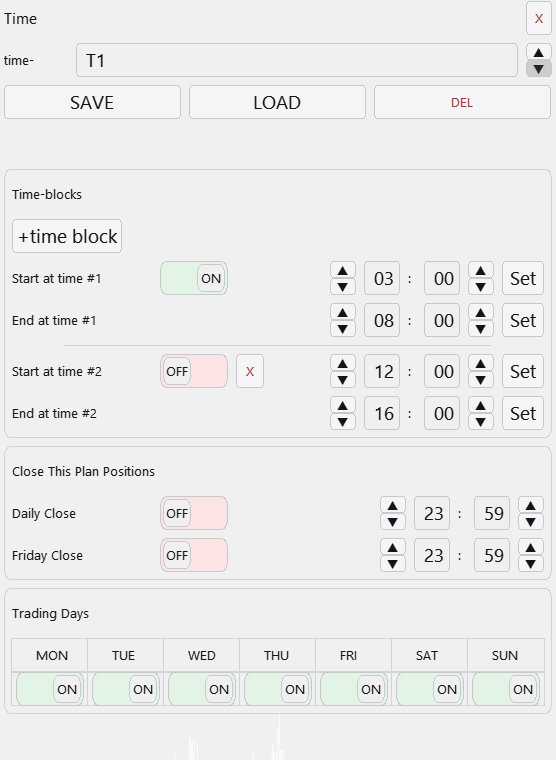
Lazy Trader treats time as a first-class rule rather than an afterthought. You can define multiple allowed blocks, keep the configuration open across midnight, restrict activity by weekday, and enforce separate daily-close and Friday-close behavior so the plan respects market microstructure as well as your idea.
This becomes especially practical in ordinary broker-specific cases: spreads may become unreasonable at night, and positions may need to be closed before the weekend instead of being left alive simply because the plan was never told to switch itself off.
The TIME menu is especially useful when you need to control:
- Session windows such as London open, New York open, or custom local broker hours.
- Overnight execution where the valid interval crosses midnight.
- Weekday permissions when a model should run only on selected trading days.
- Forced closures before daily rollover or before the weekend.
Practical rule of thumb
If spread, fill quality, or liquidity profile changes materially during the day, that belongs in TIME, not only in your head.
Well-defined time windows also make the tester more readable because they reduce the amount of random market noise the plan has to evaluate.
Other Lazy Trader sections
Config Mode and Lazy Trader 3 optimization
Config Mode turns dozens of Lazy Trader settings into controlled presets that can be iterated in Strategy Tester and then saved back into working plan cfg files.
Balanced Price Range (BPR)
BPR is the imbalance-compression model: it works with the overlap between opposite inefficiencies and lets you choose how deep into that balance zone entry should happen.
Moving Averages model
The MA model does more than “touch the fast average”: it also validates the nearest eligible fractal to the left before opening.
Classic Structure Reversal
Classic Reversal becomes relevant only when structure itself turns; it is not just a pullback model with a different stop.
Classic Structure via primary liquidity sweep
This variation opens on the first important structural violation and reads it as a sweep rather than as a full structural reversal.
Classic Structure Trend
Classic Trend participates on a pullback inside the active structure without requiring the structure direction itself to flip.
Classic Structure family
Classic Structure is the shared logic layer for three related pages: trend continuation, primary liquidity sweep, and reversal structure.
Larry-Williams model
Larry-Williams works with range extremes and supports both direct breakout continuation and return-entry logic after a raid back into the range.
Box-Fractal model
Box-Fractal uses a confirmed fractal range as the structural base for entry and stop placement rather than entering at the first raw extremum.
Market entry model
The Market model enters as soon as the shared gate allows model search and uses its own rearm options to control repeated openings.
Base config
Base config is the shared risk and management layer that sits under each model and keeps model-specific logic from drifting into risk chaos.
Position Manager
Position Manager gives each open trade its own chart-level button and lets you adjust takes, breakeven, stop-loss, and level sizing without leaving the Lazy Trader workflow.
STATUS canvas
Status canvas merges Direction, Start After, End At, Time, and Models into one live state map, so you can see what is aligned, what is still pending, and why the plan is running or waiting.
MODELS menu
Models are the executable entry modules inside the plan, and the menu is built to let many different model types coexist under one scenario.
START AFTER menu
Start After does not pick the side of the trade; it defines what must happen before the plan is allowed to begin evaluating entries at all.
DIRECTION menu
Direction defines whether the plan is fixed long-only, fixed short-only, or dynamically biased through box, MA, swing, absorption, or FVG logic.
Automatic direction detection
This section explains the combined logic of Direction plus Start After, which is where many users actually shape the market bias of the plan.
END AT menu
END AT defines when the plan stops looking for new positions, which is different from instantly flattening every already-open trade.
plan-*.cfg generator for AI agents
A machine-readable StrategySpec contract with an embedded compiler and validator for universal trading plans.
PLAN menu
PLAN is the root canvas: it is where risk, entry/stop/take, and the links to every other menu become one executable scenario.
What Lazy Trader does
Use this page when the main question is not “which button do I press”, but “what role does Lazy Trader play in the workflow at all”.